
What Is a Slitting Line? How CG Infra Processes Steel Coils
If you've ordered steel coils or sheets and the supplier mentioned "slitting," you might be wondering what that actually means. A slitting line is one of the core processes behind getting steel from a wide master coil into the exact widths a project actually needs — and it's something CG Infra runs in-house at our Raipur facility.
Here's how it works, step by step.
What Is a Slitting Line?
A slitting line is a piece of industrial equipment that takes a wide master coil of steel and cuts it lengthwise into multiple narrower strips of a specified width. Instead of ordering steel in one fixed width and cutting it yourself later (with rougher edges and more waste), a slitting line gives you ready-to-use strips with clean, precise edges from the start.
This matters for anyone further down the supply chain — fabricators, roll-forming operations, and manufacturers — who need consistent widths to keep their own production running smoothly.
How the Slitting Line Works
The process happens in five stages, all in a continuous line:
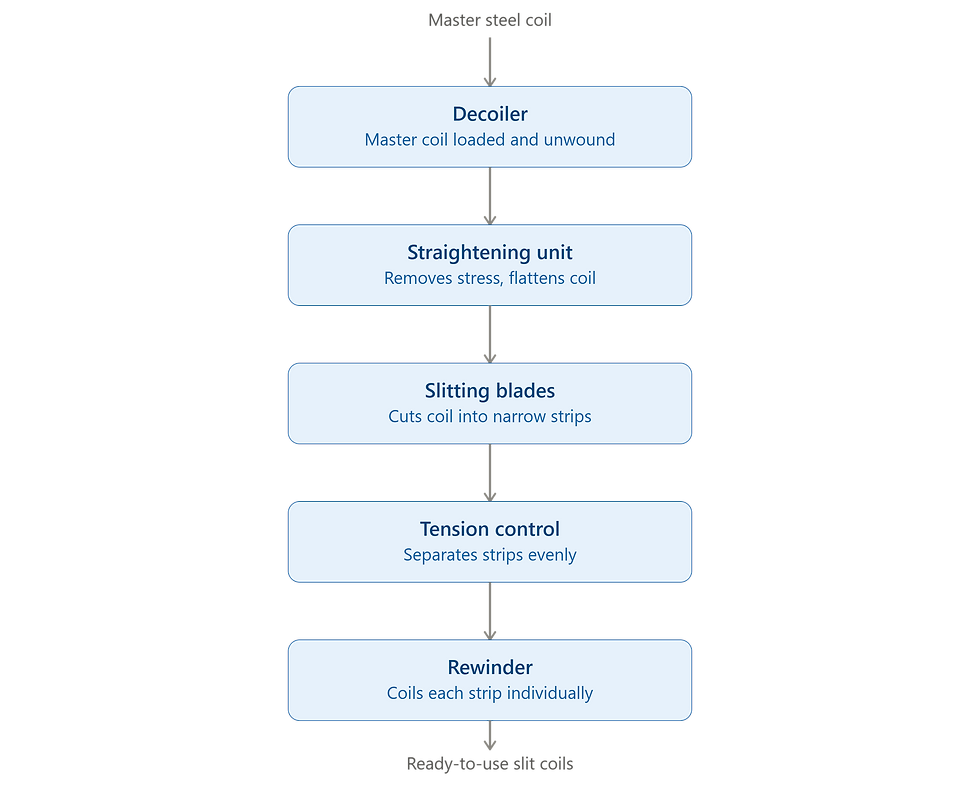
1. Decoiler — the master coil is loaded A wide master coil is mounted on a decoiler and gradually unwound, feeding the steel into the line.
2. Straightening unit — stress is removed The coil passes through a straightening unit that removes internal stresses built up during coiling, improving the steel's flatness before it's cut.
3. Slitting blades — the coil is cut to width High-precision rotary slitting blades cut the flattened coil into multiple narrower strips, according to the widths specified for the order.
4. Tension control — strips are separated The newly cut strips are separated and run under controlled tension, which keeps each strip's edge clean and prevents the strips from overlapping or shifting.
5. Rewinder — finished coils are wound Each strip is rewound into its own individual coil, ready for dispatch or for the next stage of processing, like roll forming.

Why This Process Matters
Dimensional accuracy — Every strip comes out at a consistent, precise width, which matters when that strip is going into a roll-forming line or fabrication process downstream.
Clean, burr-free edges — A well-run slitting line produces smooth edges with minimal burring, which reduces problems in later processing.
Less material waste — Slitting a coil to the exact widths needed avoids the scrap that comes from cutting oversized sheets down to size later.
Faster turnaround — Because the strips are ready to use, fabricators and roll-forming operations can skip secondary cutting steps entirely.
Slitting Line vs Cut to Length: What's the Difference?
These two services are often confused. A slitting line cuts a coil lengthwise into narrower coils — it controls width. A cut-to-length line instead cuts a coil crosswise into flat sheets of a specific length. Many projects need both — slitting for width, then cutting to length for the final sheet size.
CG Infra's Slitting Line Service in Raipur
CG Infra runs this process in-house at our Raipur facility, supplying slit coils to fabricators and manufacturers across Chhattisgarh and Central India, with branch support in Indore and Rourkela. Whether you need a single custom width or a regular supply for ongoing production, we can process master coils to your exact specification.
Get in touch with CG Infra to discuss your slitting requirements, or see our full slitting line service page for more details.
Frequently Asked Questions
What is the difference between a slitting line and a cut-to-length line?
A slitting line cuts a coil lengthwise to control its width, producing narrower coils. A cut-to-length line cuts a coil crosswise to control its length, producing flat sheets.
Why use a slitting line instead of cutting steel myself?
A properly run slitting line gives you precise, consistent widths with clean edges and far less material waste than cutting oversized stock down to size after the fact.
What happens to the steel after it's slit?
Slit coils are typically used as direct input for roll-forming lines, fabrication, or further processing into products like profile sheets or purlins.
Final Thoughts
A slitting line might be an unfamiliar term if you're not in the steel industry, but it's one of the key steps that determines how accurately and efficiently your finished steel product comes together. If you're sourcing slit coils for your own production, getting this step right upstream saves time and material everywhere downstream.
Need slit coils to a specific width? Contact CG Infra and our team will work out the right specification for your project.


Comments