
Industrial Shed Roofing Solutions in Raipur: A Complete Guide by CG Infra
Building or upgrading an industrial shed is a big investment, and the roof is the single most important decision in that build. A poorly chosen roofing system leads to leaks, rust, heat buildup, and costly repairs within just a few years. A well-engineered one protects your machinery, inventory, and workforce for decades.
At CG Infra, we've spent over three decades supplying industrial roofing solutions across Raipur and Central India, so we know exactly what factory owners, warehouse operators, and contractors need to ask before choosing a roofing system. Here's what you should know.
Why Industrial Sheds Need Specialized Roofing
Unlike residential roofing, industrial sheds face unique demands:
Large spans with minimal support structures, meaning the roofing material needs to handle wider gaps without sagging
Heavy mechanical loads from cranes, ventilation systems, and rooftop equipment
Temperature extremes inside the shed from manufacturing processes or stored goods
Chemical or dust exposure, especially in steel, cement, or chemical processing units
Heavy monsoon rainfall, which Chhattisgarh sees in significant volumes between June and September
A roofing system that ignores any of these factors becomes a liability rather than protection.
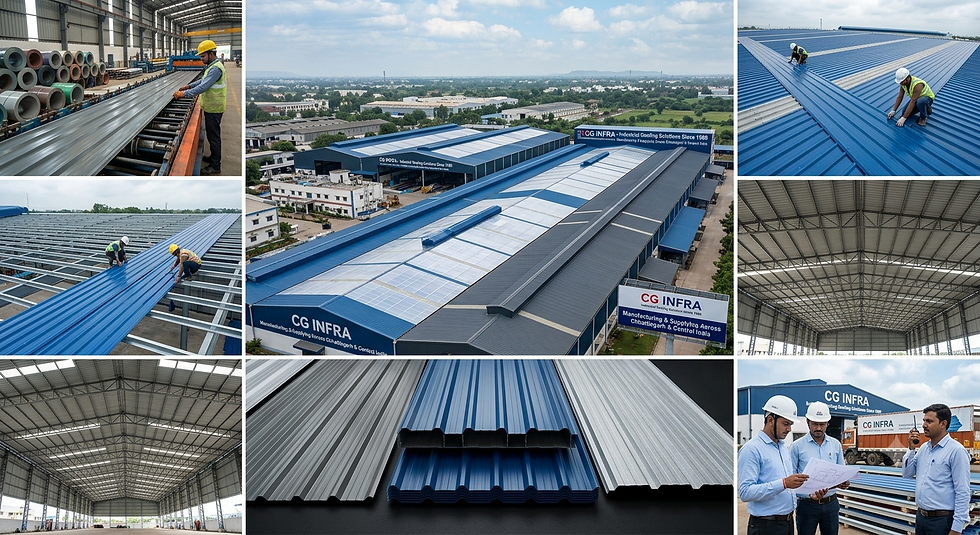
The Right Roofing Materials for Industrial Sheds
Colour Coated Roofing Sheets
Colour coated sheets are the most widely used option for industrial sheds today, and for good reason. The pre-painted galvanized steel resists corrosion far better than plain GI sheets, handles temperature fluctuation without warping, and comes in profiles engineered for long-span coverage. For sheds near industrial zones with airborne pollutants or coastal-adjacent humidity, this corrosion resistance becomes critical to the roof's lifespan.
Decking Sheets
When a shed requires a mezzanine floor, work platform, or additional structural support layer, decking sheets are used as a base for concrete flooring. They distribute load evenly and reduce the amount of reinforcement steel needed, which can meaningfully cut construction costs on larger sheds.
Purlin Structures
Purlins are the secondary structural members that the roofing sheets are fastened to, running perpendicular to the main trusses. Getting the purlin spacing, gauge, and profile right is what determines whether your roof can handle wind uplift and snow/rain load without sagging over time. This is an area where many sheds run into trouble: incorrectly spaced purlins lead to sheet deflection within just a couple of monsoon seasons.
Roll-Formed Profiles
Roll forming allows roofing sheets to be custom-shaped on-site or pre-fabricated to exact specifications, which matters a lot for sheds with non-standard spans or unusual roof pitches. It also reduces material wastage compared to using fixed standard sheet sizes, which adds up on large industrial projects.
Corrugated Sheets
For sheds prioritizing cost-efficiency without compromising structural strength, corrugated sheets remain a dependable, widely-used choice across warehouse and storage facilities.
Choosing the Right Roofing Profile
Not all roofing profiles perform the same way under load and weather stress. A few factors to weigh:
Sheet thickness (gauge) — thinner sheets cost less upfront but are more prone to denting and reduced wind-load resistance
Profile depth — deeper corrugations generally offer better structural strength across longer spans
Coating type — standard galvanized vs. colour coated vs. specialized anti-corrosive coatings, depending on your industry
Insulation requirements — for sheds storing temperature-sensitive goods, insulated roofing panels significantly reduce energy costs for climate control
Common Mistakes Factory Owners Make
Through years of supplying roofing materials across Raipur's industrial belt, a few recurring issues show up:
Choosing the cheapest sheet gauge without accounting for wind load in the specific location
Skipping proper purlin engineering, leading to sagging within 2–3 years
Ignoring monsoon drainage slope, causing water pooling and premature rusting
Using mismatched fasteners that corrode faster than the sheets themselves, compromising the whole structure
Why Local Sourcing Matters for Industrial Roofing
Sourcing roofing materials from a local Raipur-based supplier rather than a distant manufacturer has real practical advantages: faster delivery for large-area sheds, easier coordination for custom roll-forming needs, and support that understands Chhattisgarh's specific climate and soil conditions. It also means quicker access to replacement sheets or repairs if anything needs attention after installation.
CG Infra's manufacturing facility in Raipur has an annual capacity of 15,000 MT, supported by additional services like slitting line and cut-to-length processing for precise, custom-sized roofing materials.
Get the Right Roofing Solution for Your Shed
Every industrial shed has different load requirements, span dimensions, and budget constraints. At CG Infra, we work directly with factory owners, contractors, and warehouse developers across Raipur and Chhattisgarh to specify the right combination of colour coated sheets, purlins, and decking for the specific structure being built.
If you're planning a new industrial shed or replacing an aging roof, get in touch with our team for a site-specific recommendation and quote.
CG Infra has been manufacturing and supplying roofing sheets, decking sheets, and steel structural solutions in Raipur, Chhattisgarh since 1988.


Comments